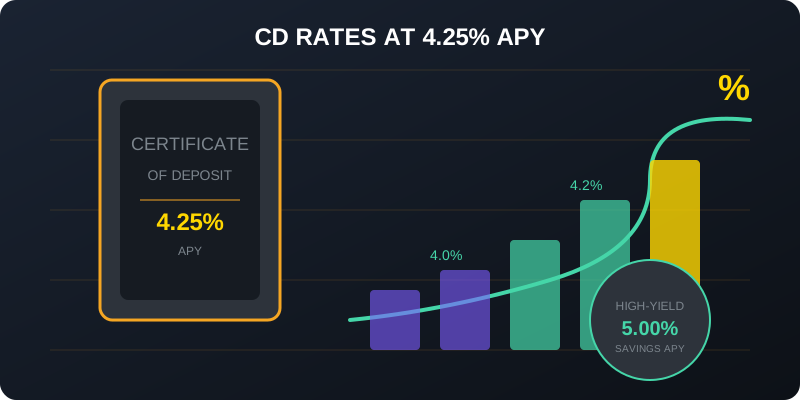
Certificate of deposit rates have reached their highest levels in nearly a decade, with some banks now offering 4.25% APY on short-term CDs. High-yield savings accounts are equally attractive, with top rates hitting 5.00% APY. For savers who've been waiting for the right moment to lock in yields, that moment is now—but there's a catch. With the Federal Reserve signaling potential rate cuts later this year, these rates may not last much longer.
Why CD Rates Are So High Right Now
The Federal Reserve held interest rates steady at its March meeting, keeping the benchmark federal funds rate at 3.50% to 3.75%. While this marks the second consecutive hold decision, Fed officials have signaled inflation expectations remain elevated at 2.7% for the year. Banks have been passing on the benefits of higher rates to depositors, but this dynamic could shift once the Fed begins cutting.
According to data from NerdWallet and Bankrate, the best CD rates currently available include:
- OMB Bank, 5-month CD: 4.25% APY
- Newtek Bank, 9-month CD: 4.20% APY
- Bread Savings, 9-month CD: 4.15% APY
These rates are substantially higher than what traditional brick-and-mortar banks offer—often 5-10x the national average. For context, a $10,000 CD locked in at 4.25% for 12 months would earn approximately $425 in interest, compared to just $50-80 at most large national banks.
High-Yield Savings: The Flexible Alternative
If you need liquidity and don't want to lock your money up, high-yield savings accounts remain incredibly competitive. Top performers include:
- Varo Bank: Up to 5.00% APY
- AdelFi: Up to 5.00% APY
- Wealthfront: Up to 4.20% APY
The trade-off? These rates are variable and will drop when the Fed cuts. CDs, by contrast, lock in your rate for the term—so if rates fall, you keep earning at today's higher rate.
The Case for Locking In Now
Here's the key insight: these high rates exist because the Fed's benchmark rate is elevated. Economists in a Reuters poll now expect the first rate cut to arrive by September 2026 at the earliest. When cuts begin, CD rates will fall too—but if you lock in a 4.25% CD today, you'll continue earning that rate regardless of what happens to the federal funds rate.
Consider a scenario where you deposit $25,000 into a 12-month CD at 4.25% APY:
- Interest earned: $1,062.50
- If rates drop to 3.50% next month and you wait: ~$875 earned
- The cost of waiting: ~$187.50 in lost interest
That's not chump change—and it illustrates why timing matters when rate cycles are turning.
What About Risk?
One of the beautiful things about CDs is their safety. As long as you stay within FDIC insurance limits ($250,000 per depositor, per account), your principal is guaranteed. There's no market risk, no volatility—just predictable returns.
Compare this to investing in the stock market right now, where the S&P 500 just posted its fifth consecutive weekly loss. For risk-averse savers or those building an emergency fund, CDs offer a compelling risk-adjusted return that simply didn't exist a few years ago.
How to Maximize Your Returns
Here's a practical strategy for the current environment:
1. Ladder Your CDs
Don't put all your money in a single CD term. Instead, create a "CD ladder" with varying maturities—3 months, 6 months, 9 months, 12 months. As each CD matures, you can reinvest at whatever rates are available then, while still capturing today's high rates on money locked in now.
2. Take Advantage of Promo Rates
Banks frequently offer promotional rates on new CD accounts. OMB Bank's 4.25% is a promo rate—set to attract new depositors. Check aggregator sites like Bankrate and NerdWallet weekly for limited-time offers.
3. Don't Ignore High-Yield Savings
If you might need the money within the next 6-12 months, a high-yield savings account makes more sense than a CD. You won't lock in a rate, but you'll earn 4-5% and maintain full liquidity. The compound interest calculator can help you compare both approaches.
4. Watch for Rate Changes
The moment the Fed signals a rate cut is coming, lock in what you can today. Rates will fall faster than most people expect once the cutting cycle begins.
The Bottom Line
We're in a rare window where savers can earn competitive yields with near-zero risk. The combination of 4.25% CDs and 5.00% high-yield savings accounts represents a generational opportunity for risk-averse investors—but this window won't stay open forever.
The Fed has held rates steady, but inflation is gradually cooling. When the first rate cut arrives—likely by September—these yields will begin their descent. If you've been waiting for the "right time" to move cash out of low-yield accounts, that time is now.
Use our Compound Interest Calculator to see how much more you could earn by moving $10,000, $25,000, or $50,000 into a high-yield account versus a traditional bank. The difference might surprise you—and it might be the nudge you need to take action.