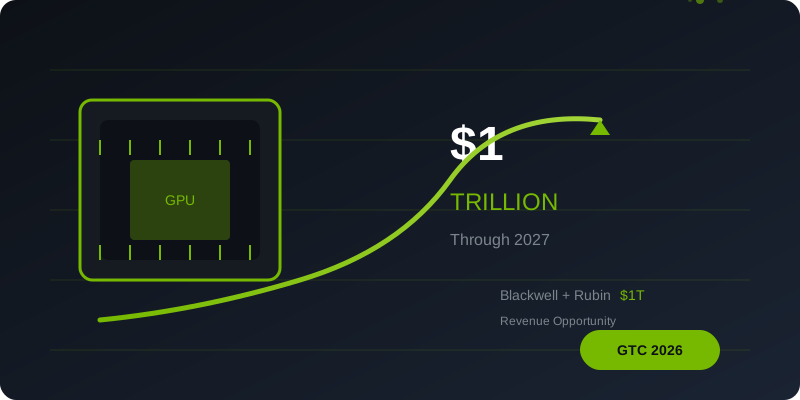
When Nvidia CEO Jensen Huang takes the stage at GTC 2026, he doesn't do small numbers. This year's developer conference in San Jose delivered the most bullish forecast in the company's history: $1 trillion in combined orders for Blackwell and Vera Rubin chips through 2027. That's not a typo. That's roughly equivalent to the entire GDP of Mexico.
The $1 Trillion Question
Just last year, Nvidia was projecting a $500 billion revenue opportunity through 2026. Now they're doubling down—and saying they'll fall short of demand. The shift? It's not about training AI models anymore. It's about inference: the massive compute power required to run AI applications in production.
"In fact, we are going to be short," Huang told the crowd. "I am certain computing demand will be much higher than that."
Why This Matters for Your Portfolio
1. The AI infrastructure buildout is just beginning. Every major tech company—Google, Microsoft, Amazon, Oracle—is racing to build AI infrastructure. Nvidia isn't just selling chips; they're selling the entire stack. The demand signal isn't speculative anymore. It's contractual.
2. The competitive moat is widening, not narrowing. Despite concerns about competition from custom chips and startups, Nvidia's partnerships with cloud providers deepened at GTC. Huang highlighted relationships with every major CSP, saying Nvidia is "bringing customers to them." That's a flywheel effect that's incredibly hard to disrupt.
What About Valuation?
This is the uncomfortable question. Nvidia trades at premium multiples precisely because of these growth rates. But here's what the bears miss: if you're right about the $1 trillion opportunity, today's valuation becomes cheap by 2027. The math is brutal but simple—double the revenue base, halve the multiple.
The Risk Factor
Let's be balanced. There are real risks: export restrictions to China, potential antitrust scrutiny, and the ever-present risk that a new player disrupts the GPU economics. But at GTC 2026, Huang didn't just announce chips—he announced an ecosystem. That's much harder to unseat.
How to Think About Positioning
If you're considering Nvidia for your portfolio, here's the framework: this isn't a stock to day-trade around quarterly earnings. It's a structural growth story where the timeline is years, not quarters. The question isn't whether AI compute demand exists—it's whether you believe Nvidia will capture the majority of it.
For long-term investors, the compound interest effect of holding a stock that's growing revenue at 50%+ annually is profound. Even a modest position, if held over a multi-year horizon, can compound significantly given the right underlying business. Use our compound interest calculator to see how a $10,000 position in a stock growing at these rates could look over 5-10 years—but remember, past performance never guarantees future results.
The Takeaway
Nvidia's GTC 2026 wasn't a marketing event—it was a thesis confirm. The $1 trillion forecast isn't hype; it's based on backlog conversations with enterprise customers who are building AI into their core infrastructure right now. For investors, the opportunity is real. The question is whether you believe the numbers—and whether you have the stomach for the volatility that comes with a stock this ambitious.
If you do believe in the AI infrastructure story, dollar-cost averaging in over time is the most prudent approach. The compound effects of staying invested in a hypergrowth stock beats timing the dips every time.