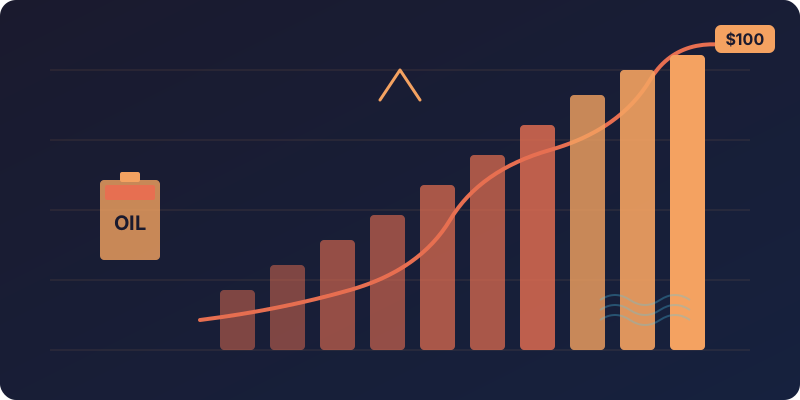
Brent crude just did something it hasn't done since August 2022—close above $100 per barrel. The settlement at $100.46 came after Iran's new supreme leader Mojtaba Khamenei declared the Strait of Hormuz would remain shut. WTI surged 9.7% to $95.73. Markets barely budged at the IEA's record 400-million-barrel coordinated reserve release. That's how serious this is.
The Strait Problem
Let's be clear about what's happening: roughly 20% of the world's oil supply flows through the Strait of Hormuz. When Iran's leadership signals that channel stays closed, markets aren't pricing in current supply—they're pricing in chronic disruption risk. The IEA's reserve release was the largest in history, and it barely registered. That's your first signal this is different.
What This Means for Your Wallet
1. Gas prices going up. If you thought $3.50/gallon was painful, buckle up. Oil at $100 translates to gas prices pushing well past $4.50 nationally within weeks. If you drive 15,000 miles annually at 25 mpg, that's roughly $270 more per year at the pump. Budget accordingly.
2. Inflation gets complicated. The Fed has been signaling rate cuts. $100 oil changes that calculus. Transportation costs ripple through everything—from groceries to Amazon delivery. Headline CPI will tick up, but the Fed's bigger problem is "supercore" inflation—services inflation that won't budge with rate cuts. The 30-year Treasury auction tailing at 4.871% tells you bond markets already know.
3. Your stock portfolio needs a reassessment. Energy stocks rallied Thursday—that's the obvious play. But the broader market? The S&P 500 fell 1.52%, the Dow shed 739 points, and the Nasdaq lost 1.78%. This is stagflation pricing: high oil = high costs = lower corporate margins + Fed stuck = equities under pressure.
The Trade Deficit Silver Lining
Here's something counterintuitive: the US trade deficit narrowed to $54.5 billion in January versus $66.6 billion expected. Exports hit a record $302.1 billion. Year-over-year, the deficit shrank 57.6%. That's the last clean snapshot before the Iran situation fully impacts global commerce.
The Atlanta Fed GDPNow jumped to 2.7% from 2.1% on that trade data—but this reading predates the oil shock. The next GDPNow will tell a very different story. We're looking at a Q1 that started strong and is ending instaglationary.
The Fed Is Trapped
Here's the uncomfortable truth: Powell's Federal Reserve faces an impossible choice. Oil at $100 pushes inflation back up, but the equity selloff and yield curve steepening (10-year at 4.24%, a five-week high) signal growth slowing. You can't cut rates into $100 oil without igniting inflation expectations—but you can't hold rates high forever with the labor market showing cracks.
The market is pricing in a "higher for longer" scenario that gets extended. If you're carrying variable-rate debt, that's bad news. If you're waiting to lock in mortgage rates, the spike in yields actually creates a brief window before the Fed pivots—but that window closes fast.
The Takeaway
Oil at $100 isn't just a headline—it's a fundamental shift in the macro environment. The question isn't whether this affects you; it's how you're positioning. Energy exposure makes sense as a hedge, but the broader portfolio should brace for volatility. The Fed's next move determines everything, and right now, they're cornered.
One practical step: use our compound interest calculator to model your savings growth with higher inflation assumptions. When input costs rise, the math on keeping cash in low-yield accounts gets uglier. Time to stress-test your portfolio against $100 oil scenarios.