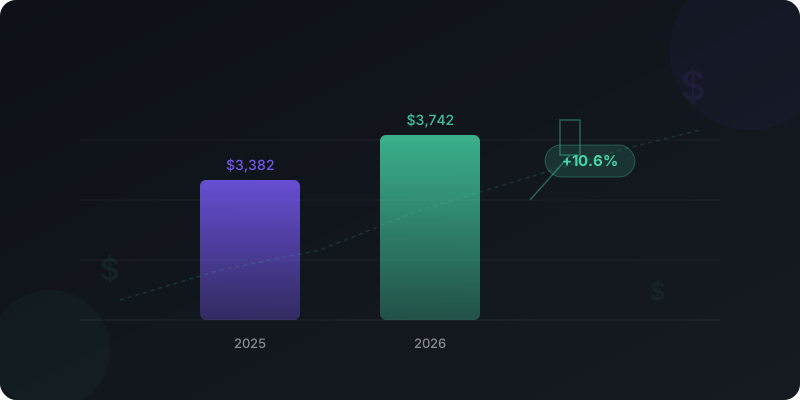
The IRS just dropped fresh filing data, and here's a number worth paying attention to: the average tax refund this season is $3,742 — up 10.6% from $3,382 at the same point last year. That's an extra $360 hitting bank accounts across the country, and for many filers, the bump is even bigger thanks to the new deductions from the One Big Beautiful Bill Act.
So why are refunds fatter in 2026? Three reasons. Higher standard deductions are shielding more of your income from tax. The new Schedule 1-A overtime deduction — 43% of filers are claiming it — is adding an average of $775 to refunds. And the SALT cap jumped from $10,000 to $40,000, which is a game-changer if you live in a high-tax state. Add it all up, and the IRS has already pushed out $109.3 billion in refunds with barely a third of returns filed.
Now here's the part I actually care about: what you do with the money matters infinitely more than the fact that you got it. A refund isn't a bonus. It's your own money coming back to you. And there are exactly five moves that will make this windfall work harder than blowing it on something you'll forget by April.
1. Kill your most expensive debt first
If you're carrying a credit card balance at 21%+ APR, your refund just became a debt weapon. Applying $3,742 to a card charging 22% saves you roughly $823 in interest over the next year alone. That's not theory — that's math.
Run the exact numbers on your balances with the Debt Payoff Calculator. Plug in your current balance, rate, and monthly payment. Then add a one-time extra payment of your refund amount. The difference in payoff date will make you want to file your taxes faster next year.
2. Build your emergency fund to $5,000
The median American household has less than $1,000 in readily accessible savings. If that's you, this refund could quadruple your safety net overnight. Even a partial allocation — say $2,000 to savings and the rest elsewhere — puts you in a dramatically better position the next time your car breaks down or your hours get cut.
Set a concrete target with the Savings Goal Calculator. It'll show you exactly how your refund plus small monthly contributions compound into real security.
3. Front-load your retirement contributions
Here's a detail most people miss: money invested in January grows all year. Money invested in December gets one month. If your refund goes into a Roth IRA in March, that's nine extra months of compound growth compared to a December contribution. Over 20 years, that timing difference alone can mean thousands of dollars.
The 2025 Roth IRA contribution limit is $7,000 (or $8,000 if you're 50+). Your $3,742 refund covers more than half of a maxed-out contribution. See what consistent contributions look like over time with the Compound Interest Calculator.
4. Prepay your highest-rate loan
Got a car loan? Student loans? A personal loan? Making a lump-sum extra payment directly toward principal reduces not just the balance, but the total interest you'll pay over the life of the loan. On a $20,000 auto loan at 7%, a one-time $3,742 payment shaves roughly 8 months off your payoff timeline and saves over $600 in interest.
For auto loans specifically, check the impact with our Auto Loan Calculator — toggle the extra payment field to see your new payoff date.
5. Split it strategically with 50/30/20
Can't decide? Don't. Split it. The most effective approach I've seen is dividing your refund using the 50/30/20 rule: 50% to financial priorities (debt or savings), 30% to something you actually want (yes, you're allowed to enjoy your money), and 20% to future-you investments (retirement, education fund, HSA).
On a $3,742 refund, that's roughly $1,870 toward debt, $1,123 guilt-free, and $749 into long-term growth. Use the Budget Split Calculator to customize the ratios for your situation.
One more thing: adjust your withholding
A big refund feels nice. But mathematically, it means you gave the government an interest-free loan all year. If your refund consistently lands above $2,000, consider updating your W-4 to reduce withholding. That puts an extra $150-300 in every paycheck instead of one lump sum in March. Same money, better cash flow, zero interest lost.
The 2026 filing season is barely a third of the way through — roughly 51.5 million returns filed out of 164 million expected. If you haven't filed yet, you've still got time to maximize your deductions, especially the new ones. And if your refund has already landed, the worst thing you can do is let it sit in a checking account earning 0.01% while your credit cards charge you 22%.
Open a calculator. Run the numbers. Make a plan. That's how $3,742 becomes the start of something bigger.